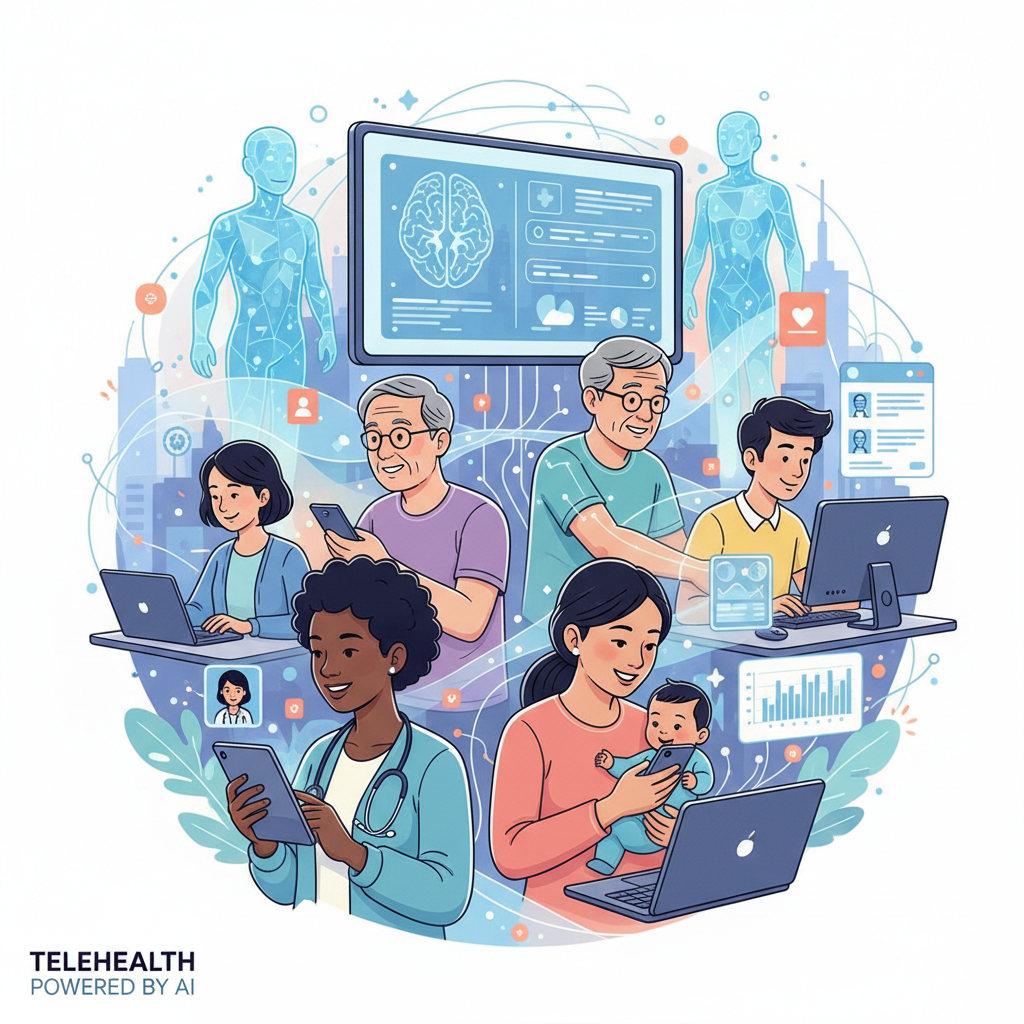
How AI Technology is Transforming Telehealth Services
Medical Disclaimer: This article is intended for informational purposes only and should not be considered medical advice. Always consult a healthcare professional before making decisions about your health.
If you're asking how AI technology is transforming telehealth services, here's what you need to know...
AI technology is reshaping the landscape of telehealth by enhancing diagnostic accuracy, increasing patient engagement, and expanding access to care. Imagine having a virtual assistant in your healthcare journey that can help diagnose conditions with up to 90% accuracy, manage routine inquiries, and even allow you to access specialist care from remote locations. AI-driven platforms are not only making healthcare more accessible, particularly in underserved areas, but they are also helping reduce physician burnout by handling administrative tasks efficiently. However, it's essential to be aware of challenges such as data privacy concerns, high initial investment costs, and the need for system interoperability.
Table of Contents
Key Takeaways
AI improves diagnostic accuracy up to 90% for certain conditions.
AI chatbots handle up to 80% of routine inquiries, saving time.
Patients report 25-30% higher engagement with AI health apps.
AI reduces physician burnout by saving 1-2 hours per day on tasks.
Telehealth with AI extends care access by up to 40% in rural areas.
Data privacy and algorithmic bias remain significant challenges.
High costs and interoperability issues hinder AI adoption.
What Is AI in Telehealth?
Artificial Intelligence (AI) in telehealth refers to the use of advanced algorithms and machine learning to improve healthcare services delivered remotely. Imagine AI as a smart assistant that can learn from data, recognize patterns, and make decisions to provide better patient care. It can involve anything from a simple chatbot answering your questions to complex systems that analyze medical images to diagnose conditions.
AI in telehealth is not just about making things faster; it's about making healthcare smarter. For example, AI can help predict patient outcomes based on historical data, suggesting personalized treatment plans that improve your health journey. By integrating AI into telehealth, healthcare providers can offer more precise, efficient, and personalized care, making it easier for you to access the healthcare you need, when you need it.
In the real world, AI is already being used to monitor chronic conditions, manage medication schedules, and even provide mental health support through virtual therapy sessions. It's like having a healthcare professional available at your fingertips, offering timely advice and support.
How Does It Work?
AI technology functions through a combination of data collection, machine learning, and predictive analytics. Imagine AI as a student that learns from a vast amount of information, such as medical records, lab results, and patient feedback. It uses this data to identify patterns and make predictions about your health.
For example, AI algorithms can analyze images from an MRI or CT scan to detect abnormalities that might be missed by the human eye. This is particularly useful for diagnosing conditions like diabetic retinopathy, where AI has shown up to 90% accuracy. The system learns from each interaction, continuously improving its accuracy and efficiency.
The process involves several steps:
Data Collection: AI systems gather data from various sources, including electronic health records (EHRs), wearable devices, and patient surveys.
Data Processing: The collected data is cleaned and organized to ensure accuracy.
Machine Learning: AI uses algorithms to learn from the data, identifying patterns and making predictions.
Decision Making: Based on the analysis, AI provides recommendations or makes decisions to assist healthcare providers and patients.
In telehealth, AI can automate appointment scheduling, remind you of medication times, and even offer preliminary diagnoses based on symptoms you report. It's like having a personal health assistant who never sleeps, constantly working to improve your healthcare experience.
What Are the Benefits?
The benefits of AI in telehealth are numerous and impactful. Firstly, AI improves diagnostic accuracy. By analyzing large datasets, AI can detect patterns and anomalies that might be missed by human eyes. This leads to early diagnosis and treatment, improving patient outcomes. For instance, AI algorithms have been shown to diagnose conditions like diabetic retinopathy with accuracy rates comparable to human experts.
Another significant benefit is enhanced efficiency. AI-driven chatbots and virtual assistants can handle up to 80% of routine patient inquiries, freeing up healthcare professionals to focus on more complex cases. This not only reduces the administrative burden but also speeds up the process of getting answers to your questions. Imagine asking a chatbot about your medication side effects and receiving an immediate, accurate response.
AI also increases patient engagement. Personalized health apps and symptom checkers encourage you to take an active role in managing your health. Studies have shown that patients using AI-powered apps report 25-30% higher engagement rates compared to traditional methods. This means you're more likely to stick to your health management plan, leading to better outcomes.
Moreover, AI expands access to care, especially in rural and underserved areas. AI-driven telehealth platforms can connect you with specialists who might not be available locally, increasing access to care by up to 40% for certain specialties like dermatology and ophthalmology.
What Are the Limitations?
While AI in telehealth offers many advantages, it's important to be aware of its limitations. One major concern is data privacy. Over 60% of patients express concerns about the privacy and security of their health data when shared with AI systems. This is a valid concern, as sensitive health information must be protected from unauthorized access.
Another limitation is algorithmic bias. Studies have shown that some AI algorithms exhibit racial bias, potentially leading to disparities in care access. For example, one study found that an algorithm assigned significantly lower risk scores to Black patients than equally sick white patients, affecting the level of care they received.
High initial investment costs also pose a challenge. Developing and integrating AI solutions into existing telehealth platforms can be expensive, with costs ranging from $500,000 to several million dollars. This can be a barrier for smaller practices looking to adopt AI technology.
Interoperability issues further complicate AI integration. The lack of standardized data formats means that over 70% of AI solutions require custom integration efforts, delaying implementation and increasing costs. Additionally, the "black box" problem, where AI decision-making processes are not easily explainable, raises ethical concerns about accountability when errors occur.
Can I Get Help Online? How DirectCare.ai Can Help
As AI technology continues to evolve, platforms like DirectCare.ai are leading the way in integrating AI into telehealth services, making healthcare more accessible and efficient for patients like you.
What Is DirectCare.ai?
DirectCare.ai is an innovative telehealth platform that leverages AI technology to provide personalized healthcare services. By connecting you with healthcare professionals and offering a range of services, DirectCare.ai aims to make healthcare more convenient and effective. Whether you need chronic care management or weight loss support, DirectCare.ai offers tailored solutions to meet your needs.
How DirectCare.ai Uses AI
DirectCare.ai utilizes AI to enhance patient care through advanced data analysis and personalized recommendations. By analyzing your health data, the platform can suggest treatment plans, monitor your progress, and provide timely reminders for medication or appointments. It's like having a dedicated health coach guiding you every step of the way.
10-Step Patient Journey
Initial Consultation: Connect with a healthcare provider via video call.
Data Collection: Share your health history and current concerns.
AI Analysis: AI algorithms analyze your data to identify potential issues.
Personalized Plan: Receive a customized care plan based on AI insights.
Regular Check-ins: Schedule follow-up appointments to monitor progress.
Medication Management: Get reminders and support for medication adherence.
Symptom Tracking: Use AI-powered tools to track symptoms and adjust care.
Feedback Loop: Provide feedback to improve AI recommendations.
Continuous Improvement: AI learns from your data to refine care plans.
Outcome Evaluation: Assess health outcomes and adjust plans as needed.
7 Specific Services
Chronic Care/RPM: Manage chronic conditions with remote patient monitoring.
Weight Loss: Access personalized weight loss plans and support.
Sexual Health: Receive confidential advice and treatment options for sexual health concerns.
Hair Loss: Explore treatments and solutions for hair loss.
Women's Health: Access specialized care for women's health issues.
Men's Health: Get support and treatment for men's health concerns.
Supplements: Discover personalized supplement recommendations.
What Can I Do Right Now?
If you're interested in exploring AI-powered telehealth services, there are several steps you can take right now:
Research Platforms: Look into AI-driven telehealth platforms like DirectCare.ai to understand the services they offer.
Consult with Your Doctor: Discuss the possibility of integrating AI into your healthcare plan with your healthcare provider.
Try AI Tools: Experiment with AI-powered health apps or symptom checkers to see how they can assist you in managing your health.
Stay Informed: Keep up-to-date with the latest advancements in AI technology and telehealth to make informed decisions about your care.
Address Concerns: If you have privacy concerns, ask providers about their data protection measures.
FAQ
What is telehealth?
Telehealth is the use of digital communication technologies to provide healthcare services remotely.
How accurate are AI diagnostic tools?
AI diagnostic tools can achieve up to 90% accuracy for certain conditions, comparable to human experts.
What are the privacy concerns with AI in healthcare?
Privacy concerns include the potential for unauthorized access to sensitive health data.
Can AI replace doctors?
No, AI is designed to assist healthcare professionals, not replace them.
How does AI improve patient engagement?
AI increases engagement by providing personalized health recommendations and reminders.
What is algorithmic bias?
Algorithmic bias occurs when AI systems produce unfair outcomes due to biased data.
How can AI reduce physician burnout?
AI reduces burnout by handling administrative tasks, saving physicians 1-2 hours per day.
What is the "black box" problem?
The "black box" problem refers to the lack of transparency in how AI makes decisions.
How much does it cost to implement AI in telehealth?
Costs can range from $500,000 to several million dollars, depending on the complexity.
What role does AI play in chronic care management?
AI helps monitor chronic conditions and provides personalized care plans.
How does AI expand access to healthcare?
AI-driven telehealth platforms connect patients with specialists remotely, increasing access.
What is DirectCare.ai?
DirectCare.ai is a telehealth platform that uses AI to provide personalized healthcare services.
How does AI ensure data security?
AI platforms implement robust security measures to protect patient data.
Can AI help with weight loss?
Yes, AI can provide personalized weight loss plans and monitor progress.
What are the benefits of AI in telehealth?
Benefits include improved diagnostic accuracy, increased efficiency, and expanded access to care.
How does AI handle routine patient inquiries?
AI chatbots can manage up to 80% of routine inquiries, providing quick responses.
What is remote patient monitoring (RPM)?
RPM involves using digital devices to monitor and manage health conditions remotely.
How does AI improve medication adherence?
AI provides reminders and tracks medication schedules to ensure adherence.
What are the challenges of AI in telehealth?
Challenges include data privacy, algorithmic bias, high costs, and interoperability issues.
Get Started with DirectCare AI
Ready to elevate your telehealth services? DirectCare AI provides comprehensive remote patient monitoring, chronic care management, and specialized programs across all 50 states.
